Essay
Pop-Ups, Considered
December 15, 2025
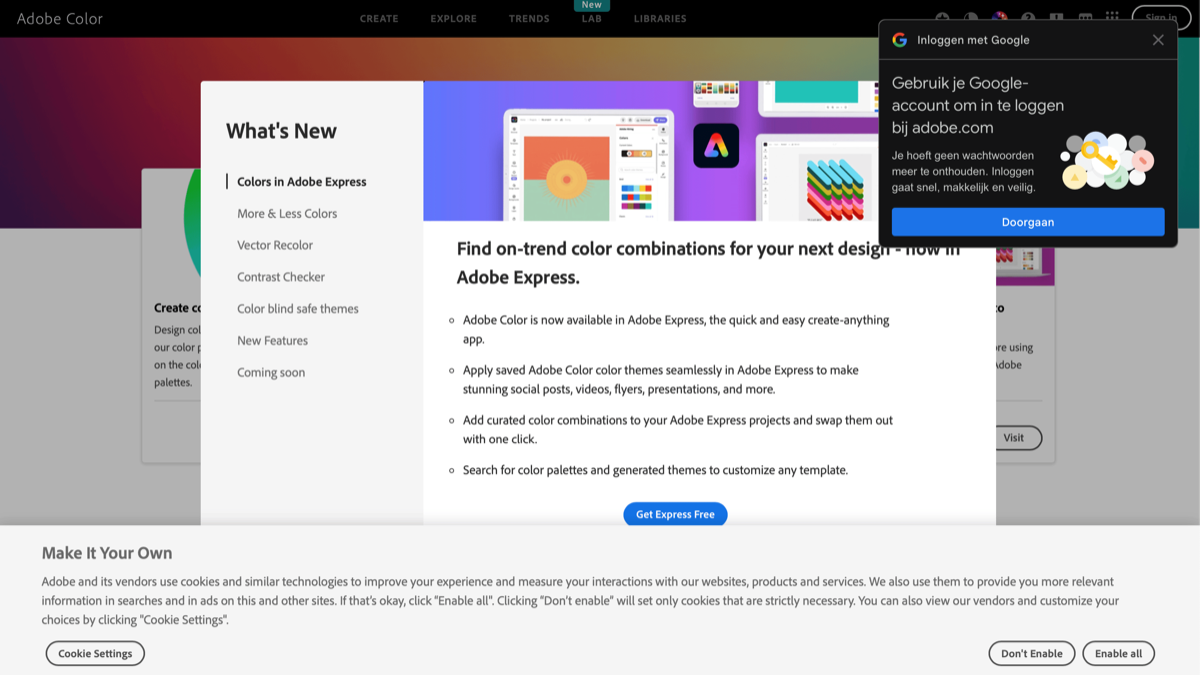
I opened Adobe's color wheel yesterday to work on color harmony for a branding project.
Before I could do that, I had to acknowledge tracking, dismiss a promotion, consider an upgrade, and decide whether I wanted to log in with Google. All stacked neatly on top of each other.
Nothing was technically broken. And yet Adobe's color service wasn't what I saw.
Four layers of interruption before I could pick a color. That's when "death by pop-up" popped into my head.
Pop-ups didn't start out as villains. They were invented as a defensive mechanism: a way to separate a brand experience from ads that could harm the company's image. Over time, that same mechanism became the most convenient way to interrupt someone mid-thought.
The irony is well-known. Ethan Zuckerman, who helped invent the pop-up ad in the 1990s, has since publicly expressed regret. Not because advertising itself is wrong, but because the pattern proved too effective at doing the wrong thing: hijacking attention.
What began as an exception quietly became a default.
“Along the way, we ended up creating one of the most hated tools in the advertiser's toolkit: the pop-up ad.”
Today, pop-ups and modals are asked to carry far more than they should. They're used for promotions, newsletter capture, consent dialogs, login shortcuts, and feature announcements. All reasonable in isolation, overwhelming together. It's a traffic jam between the user and their goal.
Convenience logins are a good example. Logging in with Google removes friction, speeds things up, and improves conversion. It also nudges users toward persistent tracking and deeper dependency. The trade-off is rarely framed as a real choice. More often than not, the alternative is to leave.
When the only meaningful opt-out is abandonment, consent becomes procedural rather than genuine. Privacy matters here because it shows how quickly short-term metrics can justify long-term erosion of trust.
Here's the real problem with pop-ups: they break context. They interrupt the user's mental model, reset attention, and train dismissal reflexes.
We've all learned where the "close" button usually lives. That alone should tell us something.
Banner blindness, ad blockers, and reflexive rejection aren't user failures. They're adaptive behavior. When interruption becomes the norm, users protect themselves.
Research shows that 73% of users immediately leave websites with intrusive pop-ups. That's not a small problem. That's three-quarters of your traffic deciding your site isn't worth the hassle.
The more aggressively pop-ups are used to "surface value," the less value is actually perceived.
And yet, the business case for pop-ups is real. They work.
When Broomberg added strategically timed pop-ups to their blog posts, they saw a 72% increase in leads. Exit-intent pop-ups can reduce cart abandonment by 10-15%. Email capture pop-ups regularly convert at 3-5%, sometimes higher.
These aren't made-up numbers. They're why every marketing team faces pressure to use them.
But here's what those case studies don't show: the long-term cost.
Research from HubSpot found that 73% of users have a negative perception of websites with intrusive pop-ups. Another study showed that 81% of users have closed a web page specifically because of a pop-up. These aren't edge cases. This is the majority of your traffic making a judgment call about whether your site is worth the hassle.
Once a customer mentally categorizes your site as "annoying," trust is damaged for all future interactions. And brand trust, unlike conversion rates, doesn't show up in this quarter's dashboard.
Apple understood this decades ago.
Their Human Interface Guidelines are explicit about modality. The guidelines emphasize three core principles: clarity, deference, and depth. Deference means the interface recedes to let content shine. It means respecting the user's attention as a finite, precious resource.
Apple's guidance on modals is blunt: "Minimize the use of modality. Generally, people prefer to interact with apps in nonlinear ways."
The guidelines discourage modals for promotions, feature announcements, optional sign-ups, or anything that can live inline. Instead, they favor inline messaging, progressive disclosure, and contextual placement.
This isn't just aesthetic preference. It's philosophy. Apple builds systems where interruption is reserved for moments that truly demand it: irreversible actions, critical errors, situations where proceeding without confirmation could cause real harm.
When modals are used beyond their narrow role, they stop signaling importance and start signaling noise.
This is what separates platforms people trust from platforms people tolerate.
Good products don't need to shout. They understand context, respect timing, and place information in the flow instead of on top of it.
Promotions can happen on the page. Errors can be handled inline. Upgrades can be suggested when value is already felt.
Pop-ups still have a place, but that place is narrow. Use them when interruption is the most respectful option: irreversible actions, critical errors, moments that truly demand immediate attention.
Outside of these cases, interruption quickly turns into misuse.
I love Adobe's Color tools. They're generous, capable, and genuinely useful. What I struggle with is the feeling of being interrupted at the exact moment I'm enjoying them.
That friction doesn't make me curious about the broader suite. It makes me cautious. And caution is a quiet form of brand erosion.
The best advertising a product can have is its usefulness, clearly experienced. If a value proposition needs a modal to be noticed, it's either not ready yet, or it's being shown at the wrong moment.
Here's the paradox: the metrics say pop-ups work. The research says they destroy trust.
Both are true.
The question isn't whether pop-ups convert. They do. The question is what you're optimizing for: this quarter's email list, or next year's relationship with your users.
Pop-ups aren't going away. But every time someone has to click through many of them to achieve a task, it hurts the legitimacy of the tool and it's provider. And once lost, it's hard to win back.
Especially when all I wanted to do was pick a color.