Product Designer · Lepaya · 2023
Learning App + AI Coach
An in-app AI coach that helps learners set an intention before their training track — Lepaya's first.
Roles & responsibilities
- Timeline
- Product Designer · Mar–Jun 2023AI learning solutions teamProduct Designer · Sep–Nov 2023Learning App team, onboarding
- Team
- Cross-functional product teamProduct manager, tech lead, developer, learning science lead, impact lead, learning design specialist, product data analyst
- Collaboration
- I owned the design process end to end and co-led research and feasibility with the PM.Stakeholders ranged across learning science and delivery up to the acting CPO.
- Responsibilities
- •Workshops and hypothesesFacilitating stakeholders, mapping research into design hypotheses
- •AI conversation designBenchmarking chat patterns, writing the coach's prompts and context
- •ValidationTesting with learners and learning specialists, defining signals with the data analyst
AI-guided learning
Designing an AI conversation that gets learners to arrive with an intention
An in-app AI coach that helps a learner set an intention and goals for a training track — a course of several skill-training modules — before it begins.
The behaviour problem: learners tended not to start their prep modules until after the first live session had already happened, so many walked into training without ever setting a personal goal for it.
I designed the intake conversation end to end — from benchmarking chat patterns to the flow and the prompting itself — co-leading research and feasibility with the PM and defining the validation signals with our data analyst.
Impact
More learners set an intention before their track began, and prep-module completion rose once prep stayed open past the first live session.
Context
A fixed track, and a goal that's a guess going in
Most learners moved through a fixed training track rather than choosing their own — so intention-setting couldn't be about picking what to learn next. It had to surface the learner's own anticipated goals within a set curriculum.
Those goals were necessarily a guess going in; the real, informed ones only took shape once the learner had been through the sessions. The tension was making the upfront intention useful anyway, and giving it somewhere to land afterward.
I grounded the concept in published learning-transfer research — Dr. Ina Weinbauer-Heidel's 12 Levers of Transfer Effectiveness, specifically transfer motivation and transfer planning, which is the theoretical case for pairing an upfront intention with a later reflection.
Problem
Getting a personal goal out of a prescribed track
How do you get a learner to set a personal goal for a track they didn't choose?
Can a conversation draw out a real intention where a form field gets a shrug?
What makes an upfront intention worth setting when the learner doesn't yet know what they don't know?

Key decisions
An intention going in, a reflection coming out — and an open door between
1. Set an intention for a track you didn't choose
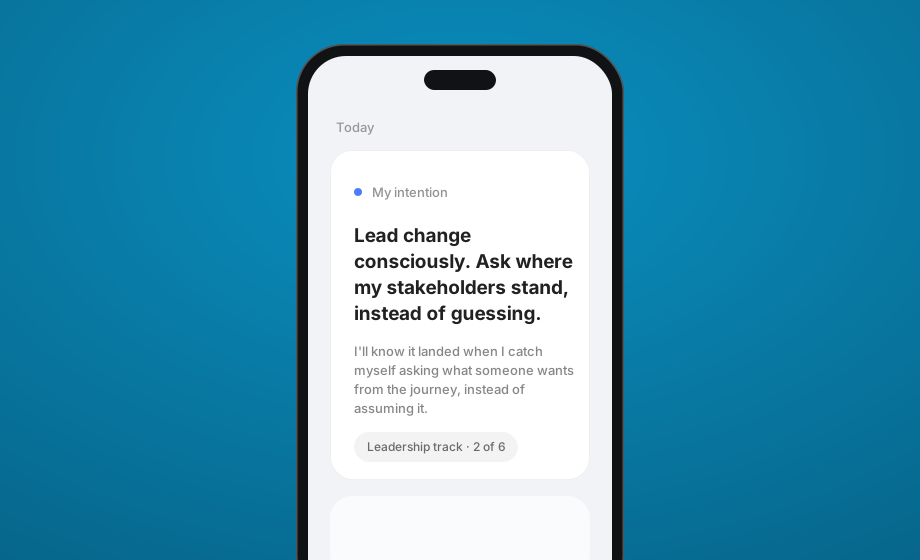
Most learners moved through a fixed curriculum rather than picking their own skills, so I designed the AI intake to draw out a personal intention within the set track, not to route what to learn next. I designed intention cards so that intention — and the goals a learner set along the way — stayed with them in the app to return to, rather than living only at the start.
Result: Testing surfaced two axes — motivation and preparedness. Motivated, prepared learners used the intention deliberately across the whole track; motivated but unprepared learners wanted to learn, but the intention step kept losing to whatever felt more urgent at work — a gap a later access change had to close.
2. A conversation, not a form
A form is static — it can't guide, adapt, or answer back. I designed the intake as a short AI conversation, capped at around five turns, that adapted to the track and to each learner's answer and could handle their own questions mid-intake. Free-form writing was the encouraged default, with subtle one-click options where they helped. One rule I wrote into its prompting: never accept a flat answer — if a learner replied "not sure," the coach asked once more what would make the track worth their time rather than moving on. I wrote the prompts and context that shaped how the coach behaved.
Result: I tested it with learners for the experience and with learning specialists for coaching quality; our Learning Science Lead backed the prompting work, and the AI engineers used it to proof conversation quality.
3. Close the loop with a reflection
An intention at the start only matters if it goes somewhere. My team concepted a post-track reflection that asked whether the learner had experienced the outcome they'd set out for — turning a one-time intake into a loop across the whole track. Another team later carried it into the end-of-track surveys.
Result: Learners who did the reflection closed the loop on their own intention — though every extra point of engagement was a fight, and trainers mattered as much as the tool in getting learners to use it.
4. Keep prep open, not gated
Most learners hadn't reached their prep modules before the first live session — so I kept prep, intention-setting included, open and completable afterward instead of locking it once the cohort moved on. Closing the door punished a timing problem instead of solving it.
Result: Prep-module completion rose meaningfully, and more learners reached the intention step at all — arriving late, but still landing on a clearer goal for the rest of the track.

Outcomes
A track with a beginning and an end that talk to each other
- Learners set a loose intention going in — not a strict goal — so it stayed useful without feeling locked-in.
- Intention cards kept that intention in the app for learners to return to and weigh against each module as they went.
- The reflection gave learners a moment to check how it actually went against what they'd set out to do — closing the arc rather than ending the track cold.
Perspective gained
You can't design motivation — only make it worth showing up
This project reinforced my belief that a product can't supply a learner's motivation. Adult learning is a fight for attention — learning always matters, but something at work or in life is always more urgent — and the most a product can do is remove every barrier for the moment the learner brings it, and make that moment count.
It was also my first time designing with AI. I prototyped the coach by writing and testing its prompts and context in a ChatGPT playground — cutting-edge at the time — and the craft turned out to be only half the job. I kept leadership at arm's length to protect the scope from creep; I'd now manage upward instead — negotiating scope in the open and showing how the prototype was actually made. When everyone is using AI for the first time and no two people agree on its limits, bringing them into the making is the work.
“The lift in prep-module completion is significant — that's real progress.”